Showing posts with label health. oil pastel. Show all posts

Saturday, March 22, 2008

THE VERSATILITY OF THE CLAY MONO TYPE

Following is a brief description of the clay mono type process as developed by Mitch Lyons some 25 or more years ago.

The clay monotype is a variation of the traditional monotype technique. A slab of stoneware clay 3/4 to 1 inch thick is pressed into a firm framed base mounted on a solid support table or bench. The surface is smoothed and leveled with the edges of the frame and is allowed to dry overnight to a “leather hard” consistency. There is no “correct” size: it can be small and portable or permanently situated in the studio. This clay base will act as the “plate” in the creation of the monotype. My current clay plate is 30x40” and is almost 6 years old. By keeping it covered with wet paper and plastic drapes it will last indefinitely.

Liquid clay-slip-is produced by mixing water and kaolin powder in a blender to a light pancake batter consistency and several coats are then brushed onto the clay slab. This slip also becomes the paint by the addition of pure pigments, dry or liquid, and is used to create the image by its application to the clay slab. The final result is a flat slab of clay in which the image is imbedded.

A moistened support, fabric or paper, is placed on top of the clay and pressure is applied using a roller or brayer. The support becomes impregnated with a thin layer of the clay resulting in a transfer of the image.

All the materials used in this process are archival and the pigments share the same light fastness as other tradition pigments.

The resulting one of kind images have characteristics unlike those produced by any other method. The variety of techniques that can be used in this process is limited only by the imagination and curiosity of the artist.

Here are several examples of how these prints can be enhanced and/or manipulated to create a variety of images,


Here the clay mono type (cmt) landscape was enhanced by adding the buildings and trees with acrlyic paint.
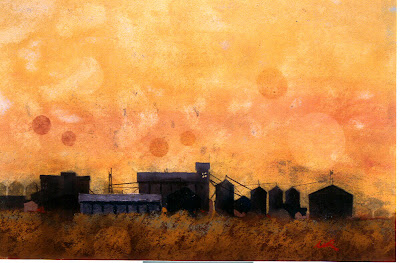

Prairie grain elevators...cmt enhanced with soft pastels


Architectural drawing...ink and pastel pencil on a cmt printed on paper


From an oil pastel series...oil pastel applied to a cmt on fabric with the borders still visible.

Wednesday, January 16, 2008

ALL ART IS DERIVATIVE


Purple on Purple Oil Pastel on Acrylic background on panel 11x14

I read or heard somewhere that "all art is derivative". Well this proves it. Looking into older images for something to post (to keep the Villager happy) this morning I found this oil pastel. I did a series of these pieces about 3 years ago. All were done on top of old clay monotypes which were printed on a non-woven fabric, thus the deep texture. Late in the series I mounted several on panels with an acrylic background. I was working in the "Windows" series 3 years ago and didn't know it!

Tuesday, December 4, 2007

PAINTING THE MUNDANE

Blogger L...... recently wrote: " I can't tell you how often I don't paint something that I REALLY want to paint because I think the subject matter is a bit trite.”
I’ve been thinking about that ever since, primarily because I have made similar decisions in the past, more than once, and I know that it is wrong. Somewhere I read or heard that it is the artist’s task to transform even the most mundane or trite subject into fine art. That being the case, there is no such thing as a trite subject, only trite art.

This is not to imply judgment on such art: it would be more appropriate to label such art “less than the very best”. I suspect that every artist’s portfolio contains an abundance of such art, a testimony to unbridled efforts to achieve that level of “fine art”.

This same blogger posted a small, simple painting of a Christmas candy cane, elegant in its simplicity and color. I don’t know if it would be considered great art, but It is pure visual delight to behold. I think she is a wonderful artist and hope she continues to paint the trite and the not so trite. I have not identified this artist because I don't have her permission. Hopefully she will so others can enjoy her blog.

Here is an example of one of my “ less than the very best” paintings. I still think the idea is a good one, but technically I did not succeed.


Red Barn pastel 20x30"

Wednesday, November 28, 2007

Lessons from life....Medicine


Intensely Orange Oil Pastel aprox 15x30

This morning I awoke with this single thought in my head: what have I learned in my 68 years of living that is worth noting? I have pondered this question before, but this morning it insinuated itself in my mind and could not be dismissed. So, I have tried to address the issue, and plan to do so in a series of small posts over time, starting with my experiences in medicine.

During my years of training, which consisted almost entirely of inpatient medicine, it was easy to imagine that life was over run with disease and illness. Only after going into private practice did I appreciate that most people are not sick, and do not have low blood counts, abnormal renal studies, or abnormal electrocardiograms.

In the years that followed I began to see the randomness of disease and illness. Yes, there are habits and behaviors that we can adopt to maximize our well being, but still there are no guarantees; we are all vulnerable to the vagaries of genetics, circumstances, and chance. Thus I have learned to appreciate my good health, and that of my family, and not take it for granted.

I have also seen the amazing resilience of the human machine and its ability to compensate and/or overcome a variety of physical and emotional assaults. This has led me to believe that good health is more than the absence of disease and illness, but also includes the ability to heal and or compensate in the presence of either.